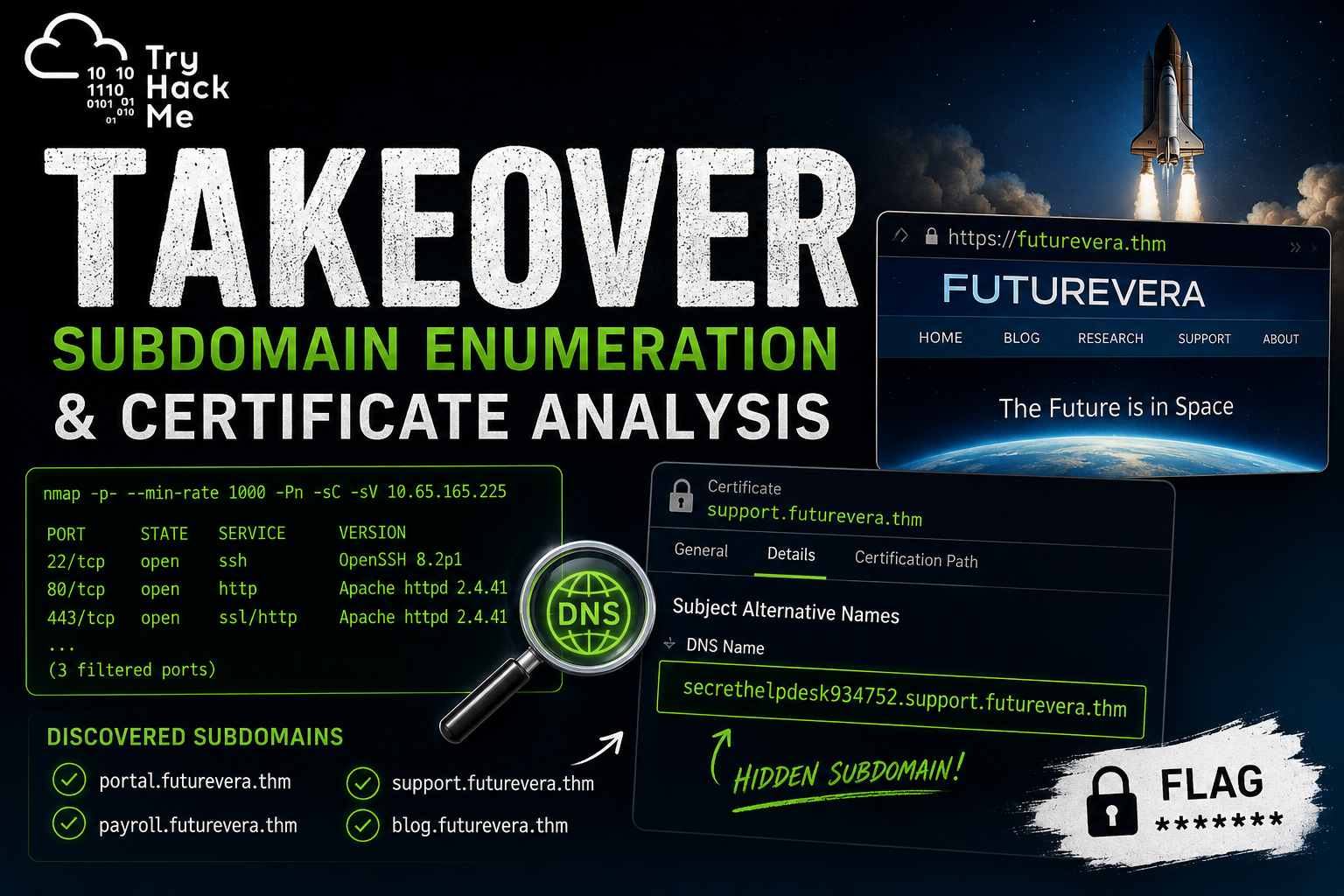
TakeOver THM - Subdomain Enumeration & Certificate Analysis
Today I worked on the TakeOver room from TryHackMe.
This challenge mainly focuses on subdomain enumeration and how hidden infrastructure can be exposed through reconnaissance techniques.
Challenge Description
Hello there,I am the CEO and one of the co-founders of Futurevera.
In Futurevera, we believe that the future is in space. We do a lot of space research and write blogs about it.We used to help students with space questions, but we are rebuilding our support platform.Recently, blackhat hackers approached us saying they could take over our infrastructure and are asking for a large ransom.Please help us identify what they could potentially take over.Website:https://futurevera.thmHint: Don't forget to add the machine IP to/etc/hosts.
Initial Reconnaissance
As usual, I started with a full TCP port scan using
nmap:Bash
sudo nmap -p- --min-rate 1000 -Pn -sC -sV -vv TARGET_IPThe scan revealed the following:
| Port | Service | Details |
|---|---|---|
| 22 | SSH | OpenSSH 8.2p1 |
| 80 | HTTP | Apache 2.4.41 |
| 443 | HTTPS | Apache 2.4.41 |
| Others | Filtered | No response |
The web server redirected users to:
TEXT
https://futurevera.thmI also noticed that the SSL certificate was expired, which can sometimes reveal useful information during enumeration.
Subdomain Enumeration
After checking the main website and performing some directory enumeration without interesting results, I moved to subdomain fuzzing using
ffuf.Bash
ffuf -w /usr/share/wordlists/SecLists/Discovery/DNS/subdomains-top1million-110000.txt \
-u http://futurevera.thm \
-H "Host: FUZZ.futurevera.thm" \
-fs 0,4605
This initially revealed two subdomains:
portal.futurevera.thmpayroll.futurevera.thm
However, something interesting happened.
Important Observation
At first, I used:
TEXT
http://futurevera.thmas the target URL for virtual host fuzzing.
After more testing and research, I retried the enumeration using:
- HTTPS instead of HTTP
- The target IP address directly
This revealed additional subdomains:
support.futurevera.thmblog.futurevera.thm
This is a good reminder that HTTP and HTTPS can behave differently during enumeration.
Certificate Analysis
Before starting directory brute-forcing on the discovered subdomains, I decided to inspect their SSL certificates.
While checking the certificate for the
support subdomain, I found an interesting entry inside the Subject Alternative Names (SANs) section.TEXT
DNS Name: [REDACTED]That hidden hostname looked extremely suspicious.
I immediately added it to
/etc/hosts and started testing it.Different Behavior Between HTTP and HTTPS
Another interesting detail:
- HTTPS redirected to the normal website
- HTTP exposed sensitive content directly
After visiting the hidden hostname over HTTP, the challenge flag appeared immediately.
For security reasons, the exact hostname and flag value are omitted from this writeup.
Lessons Learned
This room was simple but very useful for improving reconnaissance methodology.
Important takeaways:
- Always perform subdomain enumeration
- Test both HTTP and HTTPS separately
- Inspect SSL certificates carefully
- Subject Alternative Names (SANs) may leak hidden infrastructure
- Small enumeration differences can reveal entirely new attack surfaces
Even basic reconnaissance techniques can expose sensitive assets when combined correctly.
Tools Used
nmapffuf- Browser certificate inspection
/etc/hostsmodification
Final Thoughts
TakeOver is a beginner-friendly room that demonstrates how much information can be exposed through poor infrastructure management and forgotten subdomains.
A single hidden hostname inside a certificate was enough to expose the final objective.
21 views
0 comments
Discussion
No comments yet. Start the discussion!